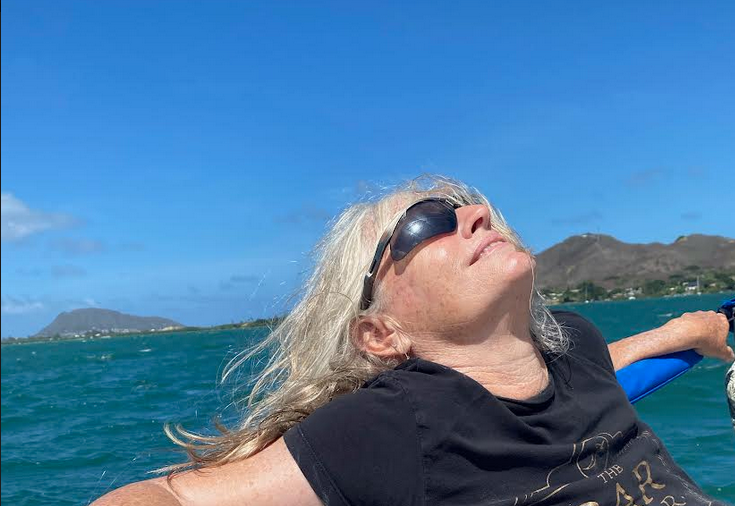
Desi Poteet: Story Seeker; Wordsmith Warrior
A Very Short Overview of My Journey as a Writer
When I was very, very young, my mother made alphabet cards for me. Using black cardboard rectangles as a base, she glued a picture of an object, and then wrote the small and capital letters it began with, as well as the word, in white. Aa for Angel. Bb for Ball. Cc for Cat…Zz for Zebra. And in this way, I learned my alphabet.
My love affair with reading began with One Fish, Two Fish, Red Fish, Blue Fish by Dr. Seuss. Oh, my, the delight of storytelling in rhymes. I loved the Cat in the Hat series… that naughty cat and those poor children caught up in the mischief of that master-of-disaster feline. The message–that everything works out–didn’t convince me to ignore my risk-averse tendencies. But Yertle the Turtle taught me to be patient with challenging situations… and that lesson has stayed with me throughout my life. Stories can teach us so much.
The earliest evidence of my first attempts at writing is a story about cats based loosely on Lady and the Tramp. I still have my handwritten stories, poor imitations of children’s s adventures, that I wrote for fun. But my “breakthrough” came in fifth grade, when I earned “Honorable Mention” for a Christmas poem, and that small triumph gave me the confidence to consider myself a writer, at least secretly.
When I was eleven, Kitty, my feline companion for six years, died, and my mother suggested I write about him as a way through my grief. Although I didn’t, my mother had planted the idea that writing could be therapeutic–an idea that grew into a life-long practice through journaling and writing memoirs, short fiction, poems, and screenplays. Writing also became a way for me to understand myself and the world around me. And, as a preteen, I wrote “I Am,” a memoir piece, as an exploration of my identity and place in the changing dynamics of my family.
Writing formal essays, especially those with a thesis to prove, requires a different set of skills, and I will always be grateful to my father who helped me translate the muddled mess from my brain into something articulate on paper. It was a simple process. I would tell him what I wanted to say, and he’d magically provide a cohesive sentence. I would type it up (on a manual typewriter–no electricity or Internet required) and then continue to write until I faced another tangle of thoughts and back I went for help. In this way, I learned how to find stronger and fewer words to convey my thoughts.
I began my college studies with an interest in psychology, but when I returned to college to finish up my BA, I decided to pursue an English degree. Commas confounded me, but I was determined to befriend them and “master” punctuation and grammar. Along the way I was fortunate to have had many mentors, but Ian MacMillan’s feedback not only helped me improve as a writer, but also launched me into a career as a professor of English, which he said was the “best gig around.”
When I was in my early teens I imagined my future self living with cats, dogs, and other creatures in a small home in the country surrounded by trees–the perfect place to write without distractions from the outside world. Later, I realized I would need to “pay” for this creative lifestyle and doing so as a writer might be a challenge. Many writers have “day jobs” to support their writing lives… and I am no exception. Currently, I teach various writing courses at a community college, lead writing workshops, and provide coaching support for writers determined to share their stories.
There have been times when I am caught up in self-doubt… something any creative individual wrestles with. And I remember one day driving over the Pali Highway to my day job, as a licensed massage therapist, questioning my commitment to writing and my future as a professional writer. I asked myself how I would feel if I had to give up doing massages. I paused and sat with the question. Nothing. Neutral. No reaction. But when I asked myself how I would feel if I had to give up writing, my belly tightened; I felt sick. It was clear that writing was my identity. As I recognized and embraced that truth, a shiny, red sports car zipped past me, its license reading: WRYTER. Ah, validation of my truth.
As an only child (until age 11), living in places with limited access to television or children my own age, I learned early on to create my own worlds and populate them with imaginary characters based loosely on real and fictitious people. As a writer, my stories most often spring from wrestling with a “What if?” situation. Although I enjoy the company of others, listening to a fascinating audio book, or watching interesting shows or films, I still hang out in my imaginary realms with characters I know far better than I know my family and friends.
(I could edit this endlessly… I am already several editing drafts in on this… but a writer has to know when it’s good enough… so, all pau for now. I will add to this with a focus on different aspects of my writing experiences… diving a little deeper.)
 wryter808
Thank you Desi for sharing your adventure in reading and writing! It was joyful to hear your stories about Dr Seuss and your thoughts about animals and living as an adult out in nature!
It was also a blessing to hear your Mom encouraging you to write about your grief and the loss of your precious childhood kitty!
I love how as an only child you used your imagination to entertain yourself and live your fantasies!
I love how as an adult you journal and teach students about the joy of writing! I enjoy how you focus on your writing; publishing a book of your own and helping young adults see the value and the joy of writing! You are a writer and inspire the rest of us to write, journal, and expand our creative talents through words! Thank you so much! Linda Bell White
Linda,
Thanks so much for your kind feedback. This is just a “quick” overview, and I plan to add to the story of my journey over time.
So many people have inspired me as both a reader and a writer. And I am so grateful I continue to grow and evolve along the way.